
 探索发现 · 交大智慧
物理与天文学院Matteo Baggioli课题组与合作团队发现烟囱梯子晶体中的玻璃态异常与反常热电输运
近日,上海交通大学物理与天文学院Matteo Baggioli课题组、马杰课题组和邢晖课题组联合剑桥大学F. Malte Grosche课题组、上海大学杨炯课题组等,在复杂晶体的晶格动力学与热电输运研究方面取得重要进展。研究团队以烟囱梯子晶体Ru2Sn3为主要研究对象,发现这种结构有序的晶体表现出通常与非晶玻璃相关的热容和热输运异常,并揭示了其微观起源。
研究表明,Ru2Sn3中的低能光学声子与声学声子杂化,产生避免交叉并重塑振动谱。这些低能声子不仅导致类似玻色峰的热容异常和低热导率,还可能与反常电阻率及热电响应密切相关。
这项研究成果以“Glass-like anomalies and unconventional thermoelectric transport in chimney ladder crystals”为题发表于《Nature Communications》。
Recently, research groups led by Matteo Baggioli, Jie Ma and Hui Xing at Shanghai Jiao Tong University, in collaboration with the group of F. Malte Grosche at the University of Cambridge, the group of Jiong Yang at Shanghai University and other researchers, have made important progress in lattice dynamics and thermoelectric transport in complex crystals. Using Ru2Sn3 as a representative chimney-ladder crystal, the team found glass-like heat-capacity and thermal-transport anomalies in this structurally ordered material and uncovered their microscopic origin.
Exceptionally low-energy optical phonons in Ru2Sn3 hybridize with acoustic phonons, producing avoided crossings and reshaping the vibrational spectrum. These excitations give rise to a boson-peak-like heat-capacity anomaly and glass-like low thermal conductivity, and may also be closely related to unconventional electrical and thermoelectric transport.
The work, entitled “Glass-like anomalies and unconventional thermoelectric transport in chimney ladder crystals,” has been published in Nature Communications.
研究背景
传统观点通常将玻色峰和异常低热导率等玻璃态特征归因于结构无序。然而,一些结构有序的晶体也表现出类似行为,说明无序可能并非玻璃态物理出现的必要条件。烟囱梯子晶体由两套相互穿插、弱耦合的子晶格构成,具有丰富的低能振动模式,是研究这一问题的理想平台。
Glassy features such as the boson peak and anomalously low thermal conductivity are conventionally attributed to structural disorder. Their observation in ordered crystals, however, suggests that disorder may not be necessary. Nowotny chimney-ladder crystals contain two weakly coupled, interpenetrating sublattices and rich low-energy vibrations, providing an ideal platform for addressing this question.
研究结果
实验发现,Ru2Sn3及相关烟囱梯子材料的热容在约8—14 K出现明显的玻色峰状异常(见图1)。第一性原理计算发现,Ru2Sn3中存在两支异常低能的光学声子。最低能光学声子与声学声子发生避免交叉,使声学色散偏离理想线性形式;模式分辨计算表明,两类声子共同产生了实验观察到的热容异常(见图2)。
Experiments reveal a pronounced boson-peak-like heat-capacity anomaly in Ru2Sn3 and related chimney-ladder materials at approximately 8–14 K (Fig. 1). First-principles calculations identify two exceptionally low-energy optical phonon branches in Ru2Sn3. An avoided crossing between the lowest optical mode and an acoustic mode strongly distorts the acoustic dispersion, and mode-resolved calculations show that both types of phonons contribute to the heat-capacity anomaly (Fig. 2).

图1 烟囱梯子晶体中的热容异常。
Figure 1. Heat-capacity anomaly in chimney-ladder crystals.

图2 低能声子及其热容贡献。
Figure 2. Low-energy phonons and their contributions to the heat capacity.
Ru2Sn3的热导率比常规晶体低一至两个数量级,具有显著的玻璃态特征(见图3)。研究还发现,Ru2Sn3的电阻率由低温T²行为交叉至线性温度行为,塞贝克系数和能斯特信号则出现宽温区平台(见图4)。理论分析表明,过阻尼声子散射能够产生T²电阻率,并将线性电阻率延伸至较低温度,为这些反常输运现象提供了可能解释(见图5)。
The thermal conductivity of Ru2Sn3 is one to two orders of magnitude lower than that of conventional crystals, exhibiting pronounced glass-like characteristics (see Fig. 3). The electrical resistivity of Ru2Sn3 crosses over from a low-temperature T² dependence to a linear-in-temperature regime, while the Seebeck and Nernst responses display broad plateaus (Fig. 4). Theoretical analysis shows that scattering from overdamped phonons can generate a T² resistivity and extend the linear regime to lower temperatures, providing a possible explanation for these anomalies (Fig. 5).
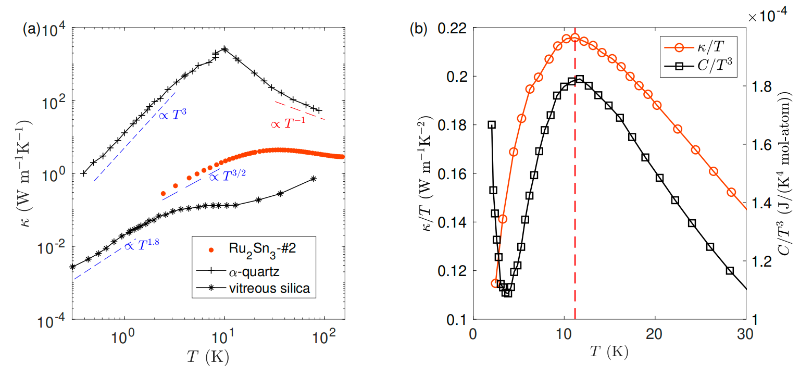
图3 Ru2Sn3中的玻璃状热导率。
Figure 3. Glass-like thermal conductivity in Ru2Sn3.

图4 Ru2Sn3中的反常电输运和热电输运。
Figure 4. Unconventional electrical and thermoelectric transport in Ru2Sn3.

图5 阻尼低能模式引起的电子-声子电阻率。
Figure 5. Electron-phonon resistivity from damped low-energy modes.
研究总结
这项研究表明,低能光学声子及其与声学声子的杂化能够在有序晶体中产生玻璃态热力学和输运特征,并进一步影响电子输运。该工作建立了从微观晶体结构到动力学低能声子振动最后影响宏观反常输运新的研究范式,为理解晶体、玻璃和反常金属之间的关系提供了新的物理视角。
The study demonstrates that low-energy optical phonons and their hybridization with acoustic modes can generate glass-like thermodynamic and transport properties in an ordered crystal and further influence electronic transport. This work establishes a new research paradigm that not only spans from microscopic crystal structure to dynamic low-energy phonon vibrations but also reveals how these vibrations affect macroscopic anomalous transport, offering a new perspective on the relationships among crystals, glasses and anomalous metals.
本研究受到国家重点研发计划、国家自然科学基金、上海市科技重大专项、上海市科学技术委员会、中央高校基本科研业务费、中国人民大学科研基金、Churchill Scholarship及Yangyang Development Fund等项目的支持。论文共同第一作者为剑桥大学博士研究生Srinivas V. Mandyam、上海交通大学博士研究生董玮涔、严晓娴和赵彬茹;共同通讯作者为上海大学杨炯教授、上海交通大学马杰教授和邢晖副研究员、剑桥大学F. Malte Grosche教授以及上海交通大学Matteo Baggioli副教授。相关合作者还包括法国波尔多大学及法国国家科学研究中心、中国人民大学、中国科学院福建物质结构研究所和美国加州大学河滨分校等单位的研究人员。
This research was supported by the National Key Research and Development Program of China, the National Natural Science Foundation of China, the Shanghai Municipal Science and Technology Major Project, the Science and Technology Commission of Shanghai Municipality, the Fundamental Research Funds for the Central Universities, the Research Funds of Renmin University of China, the Churchill Scholarship, and the Yangyang Development Fund. Srinivas V. Mandyam, Weicen Dong, Xiaoxian Yan and Binru Zhao are co-first authors. Jiong Yang of Shanghai University, Jie Ma and Hui Xing of Shanghai Jiao Tong University, F. Malte Grosche of the University of Cambridge, and Matteo Baggioli of Shanghai Jiao Tong University are the corresponding authors. The collaboration also involved researchers from the University of Bordeaux and the French National Centre for Scientific Research, Renmin University of China, the Fujian Institute of Research on the Structure of Matter of the Chinese Academy of Sciences, and the University of California, Riverside.